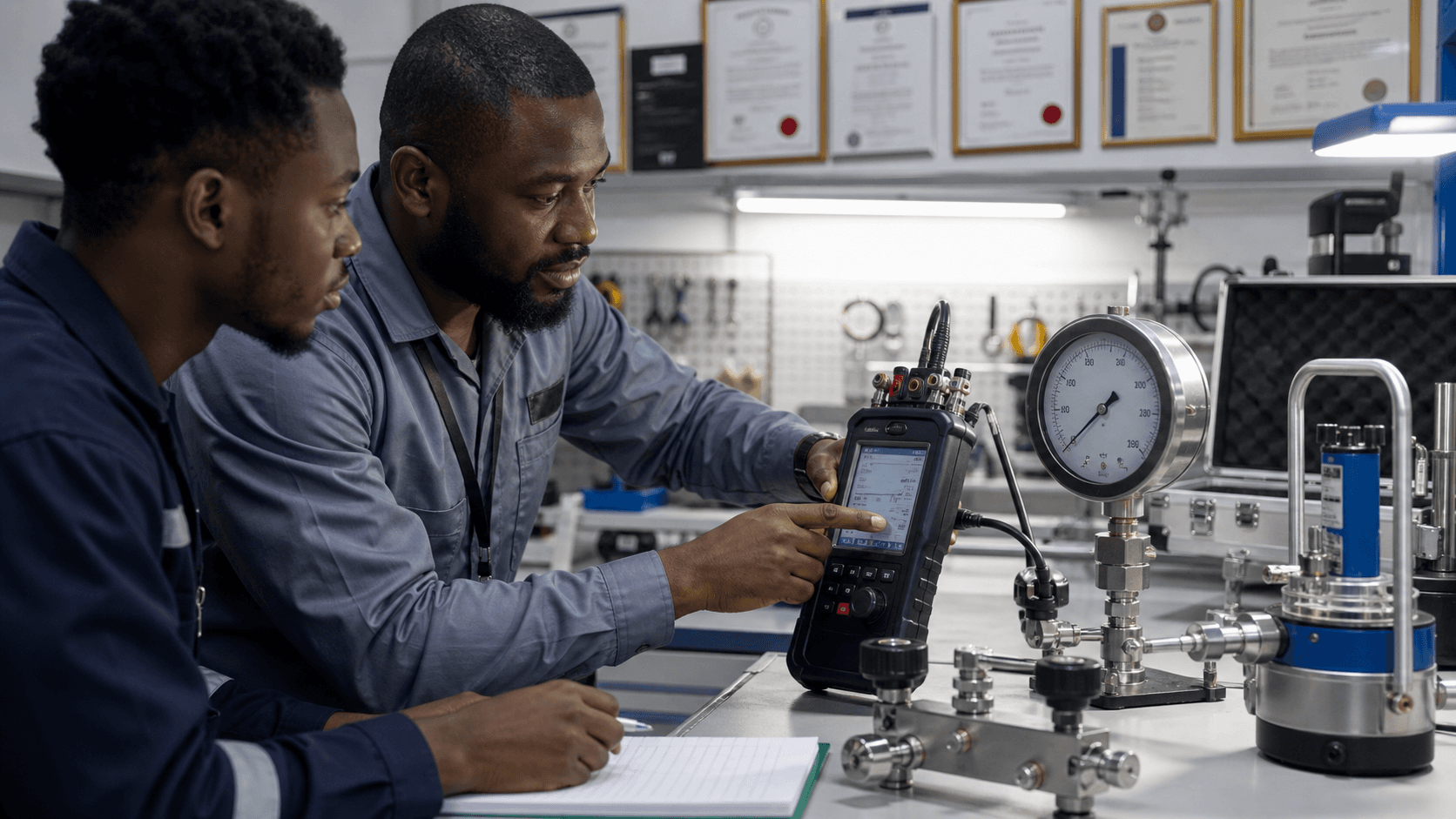
Calibration does not look dramatic from the outside. A gauge is checked. A certificate is issued. A date is recorded. The instrument goes back to work.
But in industrial environments, a wrong reading can create real trouble. It can affect product quality, billing, process safety, maintenance decisions, custody transfer, or regulatory confidence.
That is why calibration is a serious doorway for beginners.
What calibration teaches you
Calibration forces you to respect details. You learn that a pressure gauge is not just "a pressure gauge." You ask about range, unit, accuracy, connection, application, environment, frequency, and whether the client needs traceability.
You also learn that certificates matter. A buyer may ask whether the laboratory is accredited, whether the certificate includes uncertainty, whether standards are traceable, and whether the equipment is within its due date.
ISO explains ISO/IEC 17025 as a standard that helps testing and calibration laboratories demonstrate competence and valid results. For a salesperson, that is not just technical trivia. It tells you what kind of confidence the buyer is looking for.
The opportunity for a beginner
Calibration demand repeats. Instruments need periodic checks. Sites need records. Auditors ask questions. Procurement teams need approved vendors. Maintenance teams need response time.
That repetition gives you room to build relationships if you are disciplined.
Start by making a simple calibration prospect list:
- Fuel depots and LPG facilities.
- Laboratories and production sites.
- Food, mining, power, and manufacturing plants.
- Oil and gas service companies with field equipment.
- Contractors that use gas detectors, torque tools, pressure gauges, and meters.
Then learn the questions before you sell.
Questions worth asking
What instruments do you calibrate regularly?
What is the current calibration interval?
Do you need on-site or laboratory calibration?
Do you require ISO/IEC 17025 accreditation for this scope?
Are any certificates due before an audit, shutdown, tender, or inspection?
Those questions show respect for the work.
The Cookbook turns lanes like calibration into practical playbooks because a beginner needs more than motivation. You need the exact questions, documents, buyer types, and follow-up rhythm that make you useful.